Events this week have had me thinking about “trust” as it applies to our craft. My last post was a bit of a knee jerk reaction to Stephen Downes knee jerk reaction, when he said “I can’t trust anything Sue Waters and Steve Dembo write – and that’s an unhappy state to be in.” What transpired over the last couple of days around the edublogosphere was some interesting commentary about trust. Sue Waters blogged about transparency and maintaining trust, and in the comments there, Darren Draper made the point that he could sign in AS Stephen Downes and leave a comment and potentially get away with it. Darren then went on to confess to what he had done in his own blog and point out how easily one can forge another’s identity.
The word “trust” is too easily tossed about. Wikipedia noted that trust is a belief in the honesty, benevolence, and competence of another party. We are increasingly dependent on our virtual connections, yet yesterday I could not email my wife at her Comcast account because two punks (my term) hacked in and hijacked Comcast’s DNS for over five hours. All week long, many have joked about how untrustworthy Twitter has become. In fact, Hugh MacLeod had several hilarious cartoons lampooning Twitter. As Wikipedia noted, one is apt to forgive trust issues in competence areas such as these much more readily than in honesty or benevolence, and I guess I took Stephen’s questioning of trust as a deeper and more personal level.
Many have pointed out the Dark Side of trust and how easily one can be duped, but it leads me to question if this is the world I wish to live in or not. One can be cynical and assume the worst of everyone, or one can model trust and be trusting. As educators, we impact the world daily. If our actions (and our syllabi) reflects distrust, we will find it returned in multiple levels.
Yesterday, Cathy Mosca posted an interesting note on Tom Peters blog about a Trust Assessment. This is a self-diagnostic test to measure one’s Trust Quotient, developed by Charles Green. I asked myself the same question Sue did and view my integrity as one of my strengths. So I was a little shocked at how “poorly” I scored on the Trust Quotient.
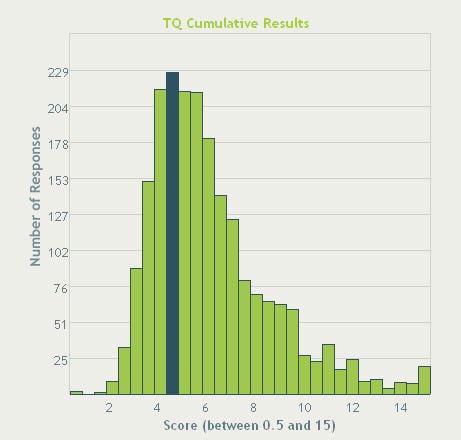
My score is in the normal mid-range of the2119 who have taken the instrument so far, though at the lower end of that range. I got a 4.7 out a a range that runs from 0.6 (low) to 15 (high). According to this instrument, my strength is my credibility, and I need to work on showing others that I care about them more than me. In other words, stop trying to control others and start trying to help others.
Maybe this instrument knows me and my role as a faculty developer better than I like!
But to return to my theme, much of my value system on trust comes from my work in the quality field. I was deeply influenced by Dr. W. Edwards Deming, who said that once one understands about quality, one will:
“…apply its principles in every kind of relationship with other people. He will have a basis for judgment of his own decisions and for transformation of the organizations that he belongs to. The individual, once transformed, will:
- Set an example;
- Be a good listener, but will not compromise;
- Continually teach other people; and
- Help people to pull away from their current practices and beliefs and move into the new philosophy without a feeling of guilt about the past.”
That has guided me for a quarter-century, and has guided my craft as a teacher. I start my classes with a discussion of what does quality mean in that class. If students see themselves as active deliverers of quality instead of passive students, then they typically will rise to meet the high expectations I set. In the same light, if they internalize that they are responsible for the quality of the learning and are working with me to achieve that learning, then high levels of trust can exist between the teacher and the students. I attempt to model honesty, benevolence and competence and seek the same from my students and colleagues. I may be disappointed from time to time, but those are the minorities. Most of my students and most of my colleagues rise to my expectations, and so I am a trusting individual and hope to stay that way.
[Photo Credit: Thorinside, doctor paradox]
Thanks for sharing this. It’s a great topic and one I am thinking about in my position. The online assessment helped!
Kia Ora Britt
What a strange and capricious thing trust is, its composition based on many factors, as you pointed out. But it has to be earned, though earning trust is more difficult for some than for others. Society has strange scales that are used for assessing trustworthiness and the consistency of those seems to be remarkably variable.
I read an article in this week’s newspaper listing embezzlers and fraudsters who had been prosecuted in the last decade or so. These people, not short of a buck, in positions of high office, had misappropriated funds or goods, some for their own benefit, some for other reasons.
I was surprised to read about the employment of a few of them who’d spent time behind bars and whose subsequent careers seemed almost unimpaired by their previous misdeeds. This is not the only time I’ve noted that position in some echelons of society seemed to be almost immune to the capricious variations associated with trust. But one might ask, who does the trusting. Trust has as much to do with point of view as does the value of the work of an artist.
What factors affect the value of a work of art? There are a lot of them, not all related in any way to what it cost initially to produce. But like trust, the value of a work of art can vary depending on the eyes of those who value it and can also dive or climb erratically, it seems, with irrational fluctuation. The common link between trust and value is people, for they are who decide the magnitudes of those attributes.
Stephen Downes and Sue Waters are people whom I hold a lot of respect for. They seem to me to be people who might well follow the same creed, one that encompasses integrity, honesty, ethics and directness of vision. Isn’t it strange that, on a point of trust, if only for a short significant moment in time, the one does not see the other in the same light?
Ka kite
Susan – I found the assessment interesting also. Glad you can use it!
Kia Ora Ken – as usual, you stretch my thinking about a subject (in good ways!)! I certainly do not want to throw the Stephen Downes baby out with the bath water! But it is funny how one reacts to people (like you) that we REALLY do not know. I consider Stephen a colleague but I consider you and Sue friends as well as colleagues…simply because of the amiable way you two come across electronically to me. So I appreciate these insightful remarks, my friend!
Tena koe Britt
I would think that the ‘Stephen Downes baby’ would be difficult to throw on its own, never mind with the bath water (metaphorically speaking of course!)
Thanks for you appreciation. I had a closer look at the Trust Assessor. I’m not surprised that you were a little shocked at how “poorly” you scored on the Trust Quotient. I must admit that I didn’t do much better with a quotient of 5.4 and recommendation to attend to simar areas of my ‘behaviour’.
I’m not disputing the result but in the words of Dickens’ Fagan “I’m reviewing the situation”. I stand by my belief in the capriciousness of trust itself by the way that it is assessed by groups within society.
I suppose that it’d be just as feasible to create a similar device to assess the value of a work of art from data entered by the owner. After all, whose opinion was drawn on when you did your assessment?
Ka kite
Britt, what a literate discussion of trust! I enjoyed it, and I like to think I actually know something about the subject, having written a couple of books on the subject.
The Trust Quotient quiz you took is mine also, and I think you view it quite rightly as well–but a couple of comments, if I may.
You didn’t score poorly, you scored right in the average–maybe below your expectations, but then in a necessarily subjective test, so probably did everyone else.
Knowing some people who have taken the test, I also suspect some of us are harder on ourselves or more rigorously objective than are others.
I don’t think subjectivity is a problem, but a fact. The quiz is about one’s own reading of others’ readings of oneself. If the test were set up as a 360 (which it will be before too long). we can get some closer answers at it.
The main purpose I had in mind was to get people to think about the components of trust, and what it means for them personally. Those are exactly the questions you seem to be grappling with, and you seem to be doing so quite thoughtfully.
For what it’s worth, another reader of the quiz, Mr. Mike Linacre, offered to do a quick psychometric analysis of the raw data. I just received this morning his results, which include:
-“Much less invalid data than usually encountered in these situations”
-“unusually reliable for an instrument of its type [via the Cronbach Alpha test]”
-“congratulations, you have produced a gem.”
I’m no psychometrician, but them sound like positive words!
The questions, by the way, were taken from the book The Trusted Advisor, of which I am a co-author, along with David Maister and Rob Galford.
Thanks for an excellent commentary and discussion.
Tena korua
Britt and Charles
Well there y’go. You never can trust who you’ll meet when writing about trust quotients on a blog 🙂
Good to meet you Charles. I’m glad you found reading the discussion enjoyable. I certainly enjoyed it.
Ka kite
from Middle-earth
Kia ora Britt
a propo Bear Scat, I’ve just noticed that the word employment in by above comment has a link to a job search in it. I certainly did not place that link in my script when I put up the comment. So this is also becoming a reflection of the commenter who, presumably is supposed to be the author of the comment. What’s your take on this Britt?
Catchya
from Middle-earth
I had not really noticed, but looked at it after your note, and it does look like Edublogs is also adding ads to comments (or whatever widget they are using is doing so).
My take is that after returning to work in January, I am going to research (and blog about) the various alternatives to setting up my own domain and taking control of my blog (and setting my commenters free!). I may end up paying and using Edublogs to do so, but I want to research my options first.
: – )
Kia ora Britt
The link that I saw was temporary, a double-blue underline. Before I had a chance to take a screen dump it had disappeared, showing that whatever the widget is, it looks for specific words to attach corresponding links to ads, but only for a short while.
What ran through my mind was if this wasn’t actually Edublog, but a virus/trojan/whatever on your site (at Edublog). I recalled Christine Martell‘s plight in August this year. Check it out.
Catchya