
Friday afternoon, I tweeted that I was checking out a very good list of top K12 Edublogs and asked on Twitter if anyone knew of a comparable list of higher education edublogs. I also noted that I liked the Education Alltop because it mixed higher ed with K-12. Jon Becker tweeted back with a good question: “How do you reconcile your last two tweets? Do you want to disaggregate or not?”
I tweeted back that I was looking for a better source of higher ed blogs, but that I liked the cross-pollination one sees in Alltop. But Jon got me thinking…
Is teaching and learning different for K-12 teachers versus higher education faculty? (I even unconsciously called them by different terms – teacher / faculty). As a higher education faculty developer, this seems a crucial question.
As many know, we spent the past week working directly with a cohort of faculty in the Teaching and Learning with Technology Institute. And it was an uplifting and energizing week! During our final potluck luncheon, several faculty noted that they now saw it as their role to become “viral” and infect their departments and schools with the integration of technology into their teaching. I think part of what energized them was the notion of TPCK – technological pedagogical content knowledge. They really liked this concept of integrating technology into the delivery of knowledge with an appreciation for how people learn.
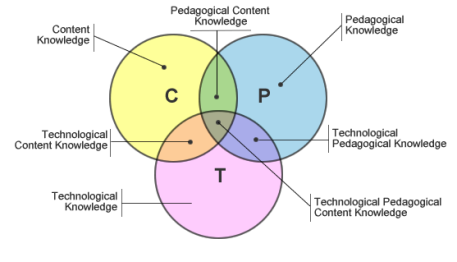
[Illustration from http://www.tpck.org/tpck/]
TPCK was introduced by Mishra and Koehler, building off earlier work done on PCK by Shulman. They argued that viewing any of the three components (technology, pedagogy, and content) in isolation from the others represents a real disservice to good teaching. I definitely buy what Mishra and Koehler are selling…and see my job in faculty development as tied to this central concept of helping content-experts use technology to improve learning.
But Jon’s question pushed me to consider the differences between pedagogy and andragogy. After all, the Greek roots for “pedagogy” mean literally “to lead the child. ” Malcolm Knowles argued for a differentiation for adults. He suggested that andragogy made the following assumptions about the design of learning:
(1) Adults need to know why they need to learn something
(2) Adults need to learn experientially,
(3) Adults approach learning as problem-solving, and
(4) Adults learn best when the topic is of immediate value.
I am not going to throw the TPCK baby out with the bathwater, but does TPCK change when applied in higher education settings, moving from technological pedagogical content knowledge to TACK – technological androgogical content knowledge?
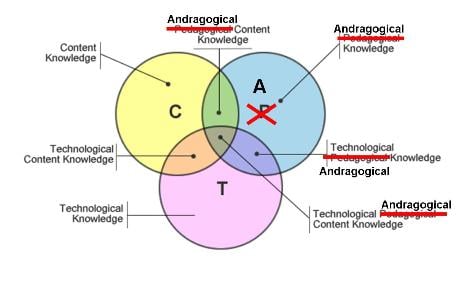
In sailing, when on tacks, one brings the boat across the wind but continues sailing in roughly the same direction. Replying to Jon, I do not want to really disaggregate the lessons I am finding in the K12 edublogs, but I do think that I need to be careful to apply the andragogy lens to faculty development and to help the faculty I work with apply that same lens to their students who are entering the adult world. The learning will stick if we make it relevant to adults. For that reason, I still feel the need to seek out other higher education bloggers to help us sort out teaching and learning in an adult world.
I would be interested in what others think. Is this simply a semantics exercise or should teaching and learning – and TPCK – at postsecondary institutions be looked at differently?
Dear Britt, thank you for your thoughtful and insightful commentary on the difference between Pedagogy & Androgogy. What is ironic is that when Matt and I developed the framework it was done almost solely based on work done with higher education faculty – not K12 teachers. So, to be fair we should have called the framework TACK (just as you suggest).
The main reason we used Pedagogy was because it is a more common and easily understood phrase – which may not have been the case with the word Androgogy.
Your points are well made and I would be interested to learn more about how you (or other people reading this blog) are thinking about this.
sincerely, Punya
Britt, I’ve always found it interesting that people believe that there’s that much of a difference between teaching adults and teaching children. If you consider Knowles’ premises, I would argue that these apply to children as well. They too need to know why they’re learning something and how it’s relevant. They also do better with experiential, problem-based learning. Personally, I think that learning is learning and this idea that children and adults learn in radically different ways is a false one.
Britt,
And why not differentiate between instructors in k12 and instructors in college/university. The vast majority of instructors in k12 are educated/trained to be teachers, to instruct the young.
The vast majority of college/univeristy instructors are educated in some other field and have taken up “teaching” as content experts and often as an secondary role at the college/university.
I think it is clear they are different. Maybe the real question is whether there should be a blend of teachers (k12) and ??? (higherED) in both locations.
As a K12 teacher who is now a Higher Ed Content Expert. I completely agree with Michele and Britt. The only change to my teaching is what motivates my students. I am just as successful in the Higher Ed as I was in K12 using the same teaching techniques. The only changes I make are (as Michelle stated) the “why they’re learning something and how it’s relevant.” They all have life experiences, and some of my 2nd graders had more life experience than I had. I would love to learn more about the combination of Pedagogy and Andragogy. My mentor teachers who have spanned K12 through college have the same view. People learn the same, the only change is how much life experience they have had and that does not have a number so much as it has a culture; or better stated: language, religion, cuisine, social habits, music and arts.
Kindly,
Mrs. “V”
AS/CST (SME in Asepsis), CHEP in Teaching, BSEEd
“Consider the ravens: they neither sow nor reap, they have neither storehouse nor barn, and yet God feeds them. Of how much more value are you than the birds!” Luke 12:24 ESV
Yesterday, I was interviewing a faculty member about the “theories of learning” that have influenced his courses. He told me that he used to believe in Knowles’ theory of adragogy, but has since decided that the principles suggested by adragogy apply to children as well. He suggested that the major difference between children and adults is that adults have more experience that they can relate to new situations. I tend to agree with him.