This week, we launched a project that has been in development for the past five months. The past few years have seen significant growth in the development of online learning in both K-12 and higher education settings. With an estimated four million college students taking at least one online course this year, and forty-four states (including Virginia) now having significant online programs in their K-12 systems, many university faculty are beginning to explore the use of online instruction in their programs and courses. In response to this growing trend and VCU faculty interest, I worked with my teammates at the CTE, Jeff Nugent and Bud Deihl, to co-develop the Online Teaching and Learning Resource Guide.
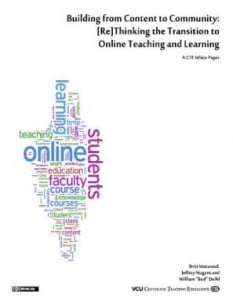
This resource guide is designed to help faculty who are seeking to transition their courses from a traditional face-to-face class to one delivered either partially or fully online. It reflects the foundation established in our White Paper from last May entitled “Building from Content to Community: [Re]Thinking the Transition to Online Teaching and Learning.” Teaching and learning online is different from traditional forms of education, requiring new practices. This guide will help faculty members reconceptualize their instructional approaches for the online environment.
In “Getting Started“, we explore how the web is changing education, what research suggests about online teaching and learning, and how to determine one’s readiness to teach online, as well as students’ readiness to learn online.
“Course Design” provides resources for translating goals and learning objectives specific to one’s course into designs that work online. Specific attention is paid to customizing Blackboard to serve one’s learning needs.
In “Teaching Practices,” we explore how the role of faculty changes online, the dimension of social presence for both faculty and students, and principles of good practice to meet instructional needs.
“Managing Online Class” covers a variety of administrative areas, such as time management, online routines, icebreakers, academic integrity, accessibility, and support services such as libraries and help desks.
The “Teaching Online Toolbox” explores a wide variety of web-based tools to facilitate instruction, such as blogs, wikis, discussion boards, screencasts, podcasts, and social media. The intent of this section is to help one integrate the right technology that enhances instruction for one’s specific discipline.
In “Online Assessment,” we look at multiple ways in which student learning can be assessed, both formatively and summatively. Techniques such as concept mapping, active learning, journaling, and testing are covered, as well as specific support applications such as LON-CAPA, Respondus, and StudyMate.
The final section provides additional resources, such as journals and online teaching websites. Faculty can also request additional consultation via a convenient online form in this section.
In this resource guide, we have assembled research-based resources and background articles on each topic, as well as “how-to” processes and best practices covering a range of topics. We hope that the resource can provide VCU faculty with a solid starting point for thinking through the challenges and possibilities of online teaching and learning. It is completely Creative Commons Sharealike, so other institutions should feel free to remix and use it as they see a need.
There is a feedback form in the final section. Either in comments here or through the form, we would welcome feedback, comments, suggestions, and additions that you see as missing from this initial publication. We have had fun putting this together, and we would welcome your thoughts and reflections on ways to improve it.
![Reblog this post [with Zemanta]](http://img.zemanta.com/reblog_e.png?x-id=7e20650d-f582-48e8-bcd0-6a04464c8061)
Dear Learning In a Flat World,
Congratulations! You have been selected to be featured on Certification Map’s The 411 on everything education! 100 Best Education Blogs list.
Your blog offers important information, news and opinions about education. This provides teachers, parents and students an insightful look at our education system and everything it has to offer. There is a plethora of information on the Internet, but because of your blog, students, teachers, parents and young professionals can easily learn from your experiences and views without all the clutter.
You have been selected as one of the best educational blogs among other educational blogs!
We recently launched CertificationMap (http://certificationmap.com/the-411-on-everything-education-100-best-education-blogs/) to help inform future teachers about the requirements for certification in their state and to ease their minds about the process. On our website is a blog, which we update often with information for teachers.
We think your readers will find the information on Certification Map much more useful than going to the Department of Education website for each state. We provide a wide range of information and news regarding anything and everything education. We’d greatly appreciate it if you would take a look at what we’ve built and consider sharing it with them.
As this is constantly a work in process we would love to hear any comments, suggestions, or questions you might have.
Again, congratulations and keep up the good work!
Best,
The Certification Map Team