(…or “It’s All Fracking Online!!!”)
I was looking over the session schedule for the SLOAN-C Conference on Online Learning and was a bit disappointed in what I saw. Here, as in elsewhere throughout the blogosphere and more importantly the mainstream education journals, one sees the term “online learning” continually bantered around. Yet, it is a term with fuzzy edges – a term that continues to evolve. While I am sure many very good presentations will occur at the SLOAN-C Conference, it appears that many will involve someone with a deck of powerpoint slides lecturing to a “class” on approaches to online learning. How ironic is THAT?!? Some appear to be taking the square peg of online learning and trying to jam it into their existing classroom structure with which they are comfortable. I must admit that the K12Online Conference was much more cutting edge than anything showing up in SLOAN-C’s conference, for the very reason that K12Online is adopting and modeling the practices being discussed.
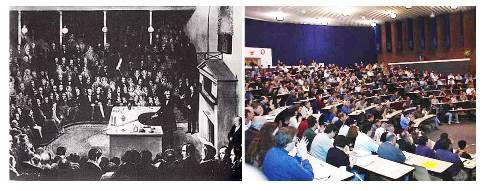
We are at an interesting juxtaposition in the evolution of online learning. After a century of little real change in classroom teaching (college lecture halls of 2008 look little different from college lecture halls of 1908), we now have tools and capabilities to actually teach and learn in new ways. Economic, administrative and social pressures are pushing faculty to consider transitioning some or all of their courses online. Students are looking for the 24/7 access to learning that they experience in their social lives. The early adopters have already made the transition, but the majority of faculty are hesitant. Some maintain that online learning is inferior to their established classroom approach. Yet, as Douglas Johnson noted in “Towards a Philosophy of Online Education” in David Brown’s (2003) Developing Faculty to Use Technology:
“Critics are already lamenting what is lost, particularly from interpersonal relations in the classroom, but the real test of online education will be what on balance is gained.”
To better understand what could be gained, one has to first define online learning.
Google defines it as follows:
Definitions of online learning on the Web:
www.wikiclone.org/en/wiki/University_of_Phoenix.html
.
If you check “online learning” in Wikipedia, it redirects you to “Electronic Learning.” But it seems to me that this is too limiting, as are the ones above. My colleagues have heard me on a variety of occasions say it’s all fracking online when hit with these limitations. It is limiting to me to simply equate online learning with distance education or worse, with electronic correspondence courses. Online learning is more than just one’s PLE/PLN. We seem to be fighting whether to equate it to a formal class taught via the internet or to serendipitous learning while surfing the web. To me, online learning is an interactive medium that applies equally to totally online courses and totally on campus courses. Just as students need oxygen and food to grow and nourish, so too do they now need the internet – as do their faculty.
My job title is “Online Learning Specialist” so I certainly have biases. I have taught online for a dozen years, and so see this topic through my own filters. I would hope that by stating my biases, we can start a conversation with others. I am interested in where you think I am on target and where I need better focus.
- I believe that online learning involves the use of the internet to promote interactive learning experiences for both students and faculty, independent of distance, time and place.
- I believe that online learning is not about the technology, it is about how the technology is leveraged to facilitate the learning. (Thanks to Bud Deihl for helping shape this one)
- I believe that online learning uses all of the seven principles of good practice first espoused by Chickering and Gamson in 1987.
- I believe that online learning is active, learning-centered, and associated with the higher order thinking skills of Bloom’s Taxonomy.
- I believe that online learning expands the walls of the classroom to incorporate global resources available anytime and anyplace.
- I believe that online learning is not individualistic, it is the result of participation in a community of learners.
- I believe that online learning is metacognitive and reflective in nature.
- I believe that online learning involves mutliple senses and learning styles.
- I believe that online learning shatters the concept of seat time and is focused on learning outcomes.
- I believe that online learning does not just happen. It is the result of hard work and good teaching.

Our students increasingly turn to the internet for answers to their questions as they arise. They are buying mobile cellular technology that increasingly provides capabilities and capacity to integrate the web into their daily lives…and into their learning if we also adopt these processes. It is time for our classes to reflect this changing world, and that suggests new ways of teaching. Putting our powerpoints up in a learning management system is not online learning. I would like to refine the discussion about what is….and how it should shape our teaching.
Be interested in your thoughts.
{Photo Credit : Dave Trapp, McGeorge Photolibrary, nswlearnscope}
![Reblog this post [with Zemanta]](http://img.zemanta.com/reblog_e.png?x-id=7038c00d-23d7-477a-9386-17f699955f9f)
I think it be good to start with what is (and is not) learning. All this stuff seems more about the environment where learning takes place instead of about what is learning? How do students best learn? What is in available online technologies to improve the efficacy of learning?
This was a good post. Online learning has really taken off with the aid of technology. I was very unsure about college classes online until I did more research. I came up with some pretty good sites about online education. My favorite by far is this one
http://mycareereducation.com/All_Articles
It really mapped out online learning. Hopefully it will help others out there.
Kia ora Britt.
This is a hardy perennial I’m afraid. I’ve even listened to a debate where the terms ‘elearning’ and ‘online learning’ were disputed as meaning the same thing. Goodness knows how anyone can draw distinctions, but they can. And they seem to have no difficulty finding arguments to support their claims.
Earlier this year I wrote an article on the topic of what elearning was all about. It seemed to spark some debate among my colleagues. These are areas of learning that are hottly debated today, often by people who have had little or no experience in the practices.
‘Twas ever thus in education. As Ken Robinson says, everyone has an interest in education. They also tend to think they know all about it, whether they have had any real experience in practicing teaching and learning or not. Online learning is no different in that regard.
Ka kite
Thanks for the post and the opportunity to comment.
I found the “I believe..” bullet points to be of interest in understanding what you are trying to sort out here.
To me it seems that one thing you are attempting to come to terms with about “online learning” perhaps rests with the distinction between formal and informal learning environments. Most of the bullets seem to fit into both categories..with a few exceptions. They are helpful as guideposts for you.
While I’ll acknowledge that important role of more informal learning through PLE/N stuff you mention, the “small pieces loosely joined” thing…I think the real challenge is with the formal educational setting.
I would be interested in how we move beyond what we believe about “online learning” to what we know from research about what teaching practices best support learning in web-based courses. I have lots of questions..here are a few:
1) It may be AFO, but is formal on-line learning for everyone? Why / why not?
2) What course design features are crucial in supporting successful online learning? Is this discipline specific?
3) Does online teaching imply the need for the development of new teaching practices? If so, what do they look like? If not, why?
4) If the informal (PLE/N) is shaping the notion of formal online learning…why do we need to even call it “online learning” anymore? Its just “L”earning.
Once again you have hit the nail on the head, pointing out that we should not be focused on the technology but on its use and results. How ironic that I am in an FLC about technology, teaching and learning. We have been focused on technology’s use, but I think I will re-examine my in light of your blog and relate them to the FLC’s efforts.
@ Frank Gulla I find it interesting that is your take on the FLC Frank…that we are focusing on the technology. I don’t see it that way at all. My view is that we have been discussing the conceptual drivers and key questions to explore (concept of engagement and examining the recent ECAR study). We have not focused on any technology tools at all…importantly we have positioned the conversation to help us explore how technology can be pressed into the service to enhance learning. At some point it does come down to how we use the technology in teaching / learning…and that involves the development of both technical and pedagogical expertise.
Thanks for the conversation from all. Lots of food for thought. A theme that I am seeing is the focus on learning first, with which I totally agree. Jeff’s comments really get at the whole notion of backwards translation by those of us teaching with the internet to those considering it. I would be the first to say that “online courses” are not for everyone, but that online learning is. Even in very hands-on classes, there are aspects that can be enhanced and better illustrated through targeted use of online learning.
Thanks for sharing valuable information. I think that the result of any online tutoring and thus the satisfaction of students largely depend upon the applied teaching strategy and student’s own initiatives. Initial hurdles can be handled easily by using latest teaching software and technology. Recently, I have been at http://tutorskingdom.com/ , where I realized the ‘real’ difference between regular classes and online learning.