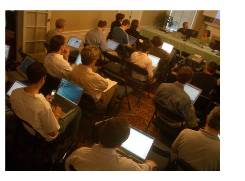
Laptops to many university students today are the equivalent of the spiral notebooks of my generation – a necessary part of attending college. Yet, students find mixed reactions when they fire up their laptop in a classroom. Friday, I had the opportunity to facilitate a brown bag discussion with a group of faculty from diverse disciplines regarding student use of laptops in university courses.
To guide the discussion, I created a wiki and placed some vignettes from around the country that illustrated both the successful use of laptops and the banning of laptops in classes. I worked with Jeff Nugent to craft this wiki so that we took a neutral position going in – presenting two sides of the laptop coin without favoring either.
Interactive Class
But in some classes, students will miss out if they leave their laptop in the dorm. Christian Jernstedt, a psychology professor at Dartmouth College in Hanover, New Hampshire, relies on Internet-connected laptops to keep his lectures hopping along.
He pioneered a system – originally with hand-held computers – that uses the college’s wireless network to pose interactive questions to the entire class. Everyone answers on his or her laptop. The replies show up on an overhead display and prompt class discussion. “The goal is to engage the student,” Jernstedt says.
He asks questions that force students to think – not regurgitate memorized facts – and sometimes make a personal connection with the course material. For example, when Jernstedt starts a unit on what stress does to the brain, he asks the students how frequently they feel stress in their lives. “Most students are surprised to see how many other people feel like they do,” he says. “And so that sort of question is, in a sense, a hook to what’s coming.”
And hooked students, he adds, are not tempted to toggle over to their Facebook profile or check e-mail. “You don’t have to think at all about what else they’re doing because they’re engaged in what’s going on,” he says.
UI College Of Engineering Thrives On ‘Laptop Classroom’
Most people are familiar with the portability of laptop computers. But what does it mean to attend class in a “laptop classroom”? At the University of Iowa College of Engineering, it means that all of the students in a 72-student computer programming class have their own laptop computers. It also means that students are more focused and involved in their studies than ever before, thanks to a first-of-its kind use of technology in the classroom.
“The students are writing more computer programs in class and learning how to use the software right in class,” says Gary Christensen, associate professor of electrical and computer engineering. “I hardly have anyone coming to me for help during my office hours anymore because we answer most questions in class… An exciting thing about the workshop was that there were very demanding computational, storage, networking and visualization requirements to present the material and the laptops and the new classroom networking were up to the challenge,” he says.
Christensen says the notion of the classroom was developed out of his classroom observations and in response to recommendations from his previous students.The teaching environment is far different from computer programming classrooms of the past in which students passively watched an overhead projection of a lecture. Now the students and professor actively engage in discussions of programming techniques while simultaneously writing small programs on their individual computers.
“The students were here about 15 minutes before I was today!” says Christensen at the conclusion of one recent class. “You don’t usually see that in any class.” And then he offers a clue to student enthusiasm: “I’m trying to make them think first, not just sit down and type a program.”
Why I Ban Laptops In My Classroom
Some years back, our law school, like many universities, high schools, and even grade schools around the country, wired its classrooms with Internet hookups. It’s the way of the future, I was told. Now we have a wireless campus, and incoming students are required to have laptops. So my first-year students are more than a bit surprised when I tell them that laptops are banned from my classroom.
As I explained in an editorial about this for the Washington Post last year,I ban laptops for two reasons. Note-taking on a laptop encourages verbatim transcription. The note-taker tends to go into stenographic mode and no longer processes information in a way that is conducive to the give-and-take of classroom discussion. Because taking notes the old-fashioned way, by hand is so much slower, the student actually has to listen, think and prioritize the most important themes. Of course, if one’s idea of a lecture is a process by which the notes of the teacher get transferred to the notes of the student without passing through the brain of either, then laptops may be the perfect transcribing tools. But if the goal is an interactive classroom, I find that laptops just get in the way.
Laptops also create a temptation to the many other things one can do there — surf the Web, check e-mail, shop for shoes, play solitaire, or instant-message friends. That’s not only distracting to the student who is checking baseballscores and statistics but for all those who see him and many others doing something besides being involved in class. It also takes the student out of the classroom discussion, which itself has collective costs for the learning environment as a whole. (In deference to the modern era, I permit two volunteers each class to use laptops to take notes that are then made available to all students.)
Taking the Classroom Out of the Internet Age
The University of Chicago Law School has removed Internet access in most of its classrooms because of a growing problem of students surfing the Web on laptops during lectures.
“Every teacher underestimates the amount of Internet surfing going on” in his or her classroom, U of C law Dean Saul Levmore said in an interview Thursday. “Whenever faculty would visit other faculty members’ classes, they would come to me and say, `You just won’t believe it. It’s astounding what happened.’ “But they never believe it’s going on in their own class,” he said.
In a recent e-mail message to students and faculty, Levmore wrote, “Remarkably, [Internet] usage appears to be contagious if not epidemic” during law classes. “Several observers have reported that one student will visit a gossip site or shop for shoes and within 20 minutes, an entire row is shoe shopping. “Half the time a student is called on, the question needs to be repeated,” Levmore added.
Law students’ use of laptops to surf the Web, read and write e-mail and play computer games during class has brought changes at a number of schools, including Harvard, Yale and Stanford. Stanford now has a posted policy that laptops and wireless Internet access may be used only for purposes relevant to the class and “not unreasonably distracting to fellow students.” And Stanford says “Harvard Law and Business [schools] have resorted to shutting down their wired connectivity in classrooms to address such problems” and Yale has considered it.
In his e-mailed announcement Wednesday, Levmore said that U of C law has removed Internet access in most classrooms “in order to ensure the value of the classroom experience.”
Faculty present represented the mixed views regarding student use of laptops in classes. Some were strong advocates and were looking for more ways to engage students. Others were concerned about the temptations laptops offer to get off message, and one math professor outright banned all technology (including calculators) from his class.
Concerns revolved around issues of focus and engagement with learning if students were also Facebooking, IM’ing, or emailing during class. Because other students can see screens, one student’s off-task viewing coiuld be disruptive to other students sitting in view of this laptop. While students have zoned out in decades past, some felt that the wireless laptop offers greater temptations to do so now. The key one faculty noted is engagement. If students are engaged in the class and are co-opted into the learning process, the laptop becomes a powerful ally for learning.
The discussion was rich as faculty reviewed opportunities associated with laptops. One faculty designates a student as a Google jockey to fact check items that come up in class. Jon Becker discussed using CoverItLive so that students can collaboratively develop class notes on sessions. (I found out later that Jon had actually been live blogging our brown bag with CoverItLive). He also noted the potential associated with backchanneling comments and questions during a session. (Ira Socol had an interesting blog post recently that discussed a similar use in his classroom.)
I doubt that any minds were changed yesterday, yet I do think each faculty left with the realization that one cannot take a laissez-faire approach to the use of laptops. One needs to consider the context under which the use of a laptop can enhance learning. One then needs to actively build that use into the curriculum and look for opportunities to model that process to students. At the same time, there are occasions in some teaching moments when laptops can become a distraction, so classroom management rules are needed to provide for “lid down” moments in the class. As in many scenarios, communicating one’s expectations can lead to improved teaching and learning involving student use of laptops.
I would be interested in your thoughts and comments. Do you have policies for your classes? Do you have innovative ways of tapping into the potential laptops afford? I would love to learn more!
{Photo Credit: Justin}
I interviewed a few professors who make good use of student laptops in the classroom for my teaching center’s podcast. A biomedical engineering professor has his students brainstorm solutions to challenge problems via their laptops, and he has his students work through simulations on their laptops during class so he can troubleshoot.
A couple of professors who teach a course on the role of narrative in various media (books, films, video games) make use of a variety of technologies in their course. In their podcast episode, they talk about ways their students acted as “Google jockeys” (I love that term) to enhance class discussions.
I think that increasing use of smart phones (iPhones and other Web-enabled cell phones) by students will pose similar challenges and opportunities. Using such devices as classroom response systems has a lot of promise, and I expect we’ll see more and more instructors using them like Christian Jernstedt in your first vignette.
The whole issue is just goofy.
First of all, who in their right mind expects students to sit and listen to them for 50 minutes (or longer) without EVER wandering off mentally? It’s unreasonable and goes against how we know the brain works. You can’t fight nature!
Second, as Seth Godin notes, if your target audience isn’t listening, it’s not their fault but yours. Just like we tell K-12 teachers: classroom management (i.e., student attention) stems from good instruction.
Finally, these digital devices – particularly in conjunction with the Internet – are the most empowering things we humans have yet created. Why don’t we start figuring out how to use them productively in class rather than banning them?
Our K-12 and higher ed students think we’re totally clueless and they’re right.
I have mixed responses to this. I teach numeracy skills for job screening to undergraduates and don’t allow calculators in most classes. Why? Well in part because most of the tests used ban them, in part too because I want them to get to grasp the processes with their brains not their fingers so they can learn useful skills for the calculator and computer age like estimating, which is often forgotten.
However I also teach students with autistic spectrum disorders and couldn’t live without a computer and the internet. Whether it’s researching core materials, checking minor details, taking legible notes of our discussion (my handwriting it dire, the students all write even worse than me) and then emailing them to my home account, their student account, occasionally to their core subject teacher etc. the technology makes the whole thing run more smoothly than before it was available.
Whilst I’m not a big fan of judging an institution by its grades, I’d love to know how the various institutions have found grades affected by their stances on using laptops. Forget the teacher/lecturer/professor and his/her biases here, what hard data do the pro-laptop lobby have that it improves results? Equally, and even-handedly, what evidence is there from the anti-lobby that laptops decrease results – which are still the way that the outside world measures learning after all.
I find it hard to understand that these discussions can still take place, that educators are still banning laptop use in favor of taking notes by hand, or switching off wireless access. Crazy.
We can’t afford to take a softly, softly approach to this issue. We can’t afford to put our heads in the sand. Students are right at home with this medium, so why aren’t we leveraging it for all it’s worth?!
Martin
http://www.thedigitalnarrative.com
I am thankful that these discussions are taking place and I thank you so much for sharing this resource. I wholeheartedly believe there is far too much benefit in laptops and wireless access to ban or limit it, but it’s also very important to recognize that there are always going to be tradeoffs involved. Being unprepared for all these problems will likely end in nothing but wasted money, classtime, and jaded teachers/students.
I personally have been part of incredibly engaging classes where tablet and collaborative software (this particular software would deliver the teacher’s notes so I could listen and take notes on the lecture). In the same classes where I was engaged and energized, other students were checking email and digg. I and other students in the class would probably agree that the professor was engaging, but these students weren’t in class to learn.
Many students are in school for certification instead of education, and that proposes a whole new set of problems. I’m not sure if there’s a 100% solution that exists, and these tradeoffs have to be seriously considered. There’s obviously the cost of infrastructure, support, training, pedagogical adaptation, discipline and preparation (let alone resources necessary to convince the others to adopt, whether the mandate came from the top down or bottom up).
Then you have all the problems that the anti-laptop camp cites. There are classroom management software suites out there that will let you block applications, websites, etc, but they come at a price. You have to know about the problems before you can find a workable solution to them, and hopefully, open discussions like these will help people find these solutions.
There are plenty of things to consider when browsing during instruction in a collegiate setting. With some up front conversations, browsing can provide a much richer texture to the classroom, differentiated by student interest, background skill, and learning styles.
I have lived the better part of almost two years in higher education classrooms (weekends primarily) where browsing an author, concept, or technical term took me deeper, for a few minutes, that the “presenter” will ever know. On multiple occasions, I went to amazon.com to purchase a title referenced only to find the extended reading as valuable as the discussion at hand.
Here’s the point, instructors open to the process of inquiry and a constructivist approach welcome the momentum they create in their topic of study. Touchdown!
Are all instructors comfortable with the process of my open notebook (computers) rather than the typical open notebook (spiral variety)? No. Why:
Instructor A: I know the sum total of what you need to know – so sit back and enjoy.
My response: I respect what you know and can be able to do, but I am not a passive learner.
Instructor B: I will control your learning because what I want you to learn is static and the experiences I structure for you conform to the parameters of learning I have set. Tools I use help me to increase my ability to share content.
My Response: I am more inquisitive and creative than you give me credit for. Let’s collaborate on what I can do show you what I learned, what I can do with my new learning. My tools help me to make more meaning from the content you present.
Instructor C: I want to make sure I can cover material and manage conversations that fit our time frame.
My Response: I respect the quality of content and pacing of instruction, which is critical to classroom management. I just need to process what you are teaching in non-linear ways.
So, what this type of learning look like in a high school? middle school? elementary school? How can we use technologies, or structure for student use of technology, to enlarge their capacity for learning, and demonstrating what they know and can be able to do?
I feel that laptops in the classroom can be very helpful for a student. I am a junior in college right now and I do not use a laptop during class because I do not have one. Most of my classes however are lecture based. I struggle trying to keep up with notetaking and attempting to get all the information to study later. With the help of a laptop, I would have all the notes and not have a sore hand to show for it.
Also, I can agree with the many distractions that can lead to having a laptop in the classroom. I see it all the time in one of my three hour classes. But I believe that the student is at fault if they do not pay attention. It is your job as a teacher to provide the knowledge and if the student is not listening, that is there own problem.